 Please Select an item from the Left dropdown Menu.
Diesel Exhaust
Emissions and
Diesel Exhaust Smoke Meters

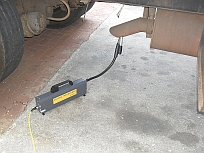
Typical modern Diesel Smoke Meter at work
Diesel Exhaust Smoke meters, also referred to as opacity meters, detect and measure the amount of light blocked in a sample of smoke emitted by diesel engines from cars, trucks, ships, buses, motorcycles, locomotives and large stacks from industrial operations. The smoke meter readout displays the smoke density giving a measure of the efficiency of combustion. This makes the smoke meter an excellent diagnostic tool to ensure proper maintenance of diesel engines for improved fuel economy and protection of the environment.
The opacity meter consists of an optical unit mounted inside a measuring head and a separate electronic control unit. The measurement principle is based on light extinction detection. The collimated beam from the light-source (SLED) is absorbed and scattered by the particulate exhaust emissions. A photodiode determines the light intensity of the attenuated beam and the corresponding opacity value is transmitted to a separate remote display. Partial flow continuous gas sampling combined with a heated and temperature controlled smoke chamber compensates for changes in pressure and test conditions to give you the most accurate readings possible.
All modern Diesel Exhaust Smoke Meters should measure diesel emissions (dark smoke) in Opacity (N) and/or Smoke Density (K) according to SAEJ1667.
There has been a lot of
misunderstanding about the Diesel Exhaust monitoring and measurement lately
all inline with the world's requirement to reduce CO2 emissions.
That is why the government introduced a by-law-model for adoption by the
different municipalities in SA as an easy guide.
Model Air Quality Management By-Law for easy adoption by municipalities 2010
by the Minister of Water and Environmental affairs.
Pages 5-7 deal with diesel exhaust emissions description and suggested
limits while Chapter 2 deals with the actual nature of diesel exhaust
emissions testing in South Africa.
Why not just use the proven
method of Gas Analyzing as done with Petrol engines?
Diesel soot is by nature oily thus quickly clogging the filters and sample
piping of a "normal" petrol exhaust gas analyser. Those maintenance items are fairly
expensive to be changed after every single test. That's why the smoke metering
method for diesel engines has been implemented by all governments. A modern
Smoke meter is a almost no-maintenance device.
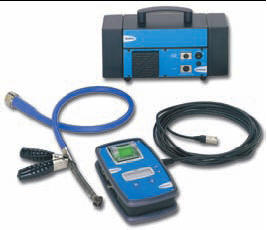
Typical modern Portable Diesel Smoke Meter
What is:
Diesel Smoke - Particles, including aerosols, suspended in the exhaust stream of a diesel engine which absorb, reflect, or refract light.
Opacity (N) - The percentage (%) of light transmitted from a source which is prevented from reaching a light detector. (also know as HSU - Hartridge Smoke Units)
Smoke Density (Km-1) - (also known as “Light Extinction Coefficient” and “Light Absorption Coefficient”) A fundamental means of quantifying the ability of a smoke plume or smoke containing gas sample to obscure light. By convention, smoke density is expressed on a per meter basis (m-1). The smoke density is a function of the number of smoke particles per unit gas volume, the size distribution of the smoke particles, and the light absorption and scattering properties of the particles. In the absence of blue or white smoke, the size distribution and the light absorption/scattering properties are similar for all diesel exhaust gas samples and the smoke density is primarily a function of the smoke particle density.

Typical modern Diesel Smoke Meter Station
What to look for when choosing a Diesel Exhaust Smoke Meter?
- First and foremost is
back up service and maintenance. Smoke Meters
have to be calibrated (or at least checked) to maintain optimum accuracy
at least once a year.
You don’t want to get something that no one can service or repair if needed. User maintenance (on modern units) is usually down to cleaning the optics when necessary. - Is it DOT/MOT tests capable?
- Are the digits clearly visible when away from the machine (at least 2 metres)?
- Can it Record the smoke values for later evaluation?
- Does it have Diagnostic capabilities?
- Does it provide any Help when you get stuck for any reason?
- Does it have a Customer Database to save their results for later printing or evaluation?
- Does it have acceptable printing capabilities? Some print on small sized paper.
- Can it include your Customer names in the Print outs?
- Can it measure in N and K-1 simultaneously
- What More does it have to offer, compare to other makes and models?
- Is it reasonable priced for what it has to offer?
Please Select an item from the Left dropdown Menu.
