 Please Select an item from the Left dropdown Menu.
Code Readers / Vehicle Data Scanners
and OBDII / EOBD / CAN vehicle diagnostics
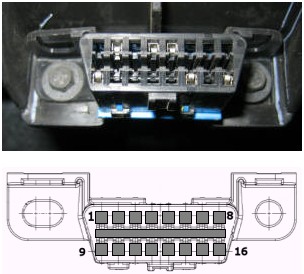
Typical modern OBD car connector
What is OBD, OBDII, EOBD and CAN: (On Board Diagnostics and Controller Area Network)
In short: It's the capability of the vehicle ECU's to communicate between each other AND to perform tests on themselves and their relevant Sensors and Actuators. A Code Reader or Data Scanner is used from humans to tap in to this communication in order to help in finding and rectifying faults with the vehicle's systems. Those devices are connected to the vehicle ECU's network through the lately standardised OBD connector.
There is a "Standard OBD" capability, enforced for all vehicles manufactured after 1996 (in USA), concerning ONLY the Vehicle's Exhaust Emissions Control. This part of the OBD concerns the Engine (and sometimes Transmission) sensors and actuators monitoring only.
"Vehicle Manufacturer Specific OBD"
capability is left to the discretion of the vehicle manufacturers and varies
greatly to say the least.
It usually involves in-depth monitoring of all vehicle systems equipped with an ECU.
Needless to say, different vehicle manufacturers have different approach to
On Board Diagnostics, sometimes differing even between same vehicle models sold in to different markets!
In SA, there is currently no enforcement for ANY OBD standard, leaving the
market largely at the vehicle manufacturers mercy when it comes to OBD
compliance.

What is a Code Reader:
A Code Reader is an specialised device designed to 'translate' the
communication between ECU's (Electronic Control Units) within a vehicle, and
to display it in understandable human format. They are also capable of
reading the memory of those ECU's and display the stored information. Code
Readers come in variety of forms, from limited basic information display to
in-depth explanation of the ECU's communication.
The very basic ones will only display the stored information from the ECU's memory (i.e. the stored Standard OBD Diagnostic Trouble Codes (DTC's) . Those are the cheapest and most limited in functionality code readers. Most of them however should be capable of instructing the ECU to erase it's memory and stored DTC's. Good for DIY or an spare unit. Those units will not (usually) read or display manufacturer specific DTC's or Live ECU data.

No matter what the configuration, advanced Code Readers should be able to Read / Erase ECU's memory and DTC's, Program New Sensor or Actuator values in to the ECU's, Display the state of ECU's Monitors and give detailed explanation of the results. A lot of Dealer Diagnostic Tools look like a "black box" and make good use of PC's advantages and the Internet.
An advanced Code Reader will be able not only to show "standard" OBD communication but also will go in-depth through all available ECU's in the vehicle and display results for manufacturer-specific DTC's, available ECU adjustments and manufacturer level diagnostics.
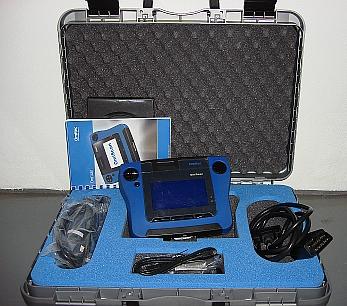
A Data Scanner is essentially an Code Reader with the added advantage of displaying Live Data values from the vehicle's ECU's, Sensors and Actuators. ( i.e. Speed Sensor, O2 sensor, Injector pulse, Ignition timing etc. etc.)
They should be able to show those values on their screen in a oscilloscope like format (plot) and in a 'digital' readout format.
Most advanced models (especially the PC based ones) will be able to store all information for later viewing, examination or printout. Some of them will be able to act as an ordinary low voltage oscilloscope too.
Data Scanners are Professional tools for vehicle diagnostics as they provide the most in-depth information and capabilities. Those devices are the closest one can get to be at a "Dealer Diagnostic Level".
In most instances they will be able to cover most available vehicle models and manufacturers in depth.
Please Select an item from the Left dropdown Menu.
