Air to Fuel Ratio ( AFR )
This is the relationship ratio between the Air needed to completely burn 1 litre
of Fuel in the combustion process. It's also called Stoichiometric ratio. In
other words, how many litres of Air is needed to completely burn 1 litre of Fuel
during the engine combustion.
The Relationship between Lambda and A/F ratio:
Because Lambda = 1.000 when the oxygen and combustibles are in perfect
Stoichiometric balance, Lambda can easily be used to calculate A/F Ratio for
particular fuels. The actual A/F ratio is simply the calculated Lambda times the
Stoichiometric A/F ratio for the specific fuel used. (14.71 for petrol). This
method is far superior to other approaches which use only one gas (CO or Oxygen)
to approximate A/F ratio, as this method uses all of the oxygen and
carbon-bearing gases to calculate the ratio of air to fuel. Now, bear in mind
that the fuel quality is extremely important and very closely involved in both
methods of calculating AFR and Lambda!
Due to the fact that fuels differ in composition from country to country (even from source to source) you may find that different gas analysers will yield different AFR Lambda results! For the results to be correct, one has to know the real fuel composition used in it's country (as a standard - Hydrogen, Carbon and Oxygen fractions), and then have a way to change this in the equation the gas analyser uses. Different fuels (Petrol, CNG, LPG, Diesel etc.etc.) have different ratios. Too bad if your gas analyser simply don't know about South African fuels!
There are of coarse, straight forward (without having to calculate Lambda first) methods of calculating AFR, one of which is using the Spindt formula published by the S.A.E. in the USA. Spindt method of calculating AFR is as complex as the Brettshneider method of calculating Lambda. Both methods ( first Lambda and then AFR, or straight AFR ) yield very similar results, so it really doesn't matter much which one your gas analyser uses, as long as it's done properly.
Providing a uniform method to relate the specific exhaust gas constituents to Air/Fuel balance (independent of the quality of the combustion process or the power produced) makes the engine tuner’s job much easier and easier to understand as well. Calculated Lambda value is based on the measurement of HC, CO, CO2, O2, NOx and other contents concentrations ( see Lambda for more info...).
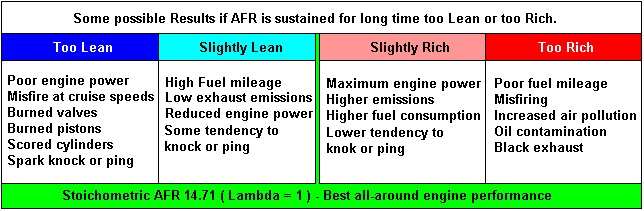
Remember the ideal (Stoichiometric) A/F Ratio is 14.71 litres air to 1 litre fuel or 14.71/1. (for petrol only, other fuels have different values!) The ideal Lambda value is 1.000 (one) below that the A/F mixture is rich and above - lean.
For example, lambda=0.8 corresponds to an Air/Fuel Ratio of (0.8x14.7) to 1= 11.76 to 1 ( e.g. lambda 0.8 = A/F ratio of 11.76 to 1 or very rich air/fuel mixture ) Low Lambda = Low AFR = Rich Mixture
Please Remember that Lambda=1 and AFR=14.71/1 are ONLY TRUE when ALL Gas Values are Within Specs!!!
You may get Lambda=1 even if say HC=1530 and CO=4.5! Lambda and
AFR are Air Fuel balance, they DO NOT represent Correctly Burning A/F Mixture!
CEF ( Engine Combustion Efficiency), however is another story. That is why we
need to understand ALL gases and only make use of Lambda and AFR as confirmation
points.
|
|
Automotive Equipment - in tune with the Future

Crypton Diagnostic Equipment Home